Today's Guest Post is brought to you by Dan Tricarico!
Dan Tricarico has been a high school English teacher for over twenty-five years. He’s the CEO of The Zen Teacher, a national speaker, and the author of three incredible DBC, Inc. books! Through his work, Dan helps busy, overwhelmed educators find calm and thrive both inside and outside the classroom. His insights have been featured in Fast Company Magazine and on numerous educational podcasts. He’s been such a valued member of our DBC family!
Today's guest post is inspired by Dan's book Write Here and Now: The Mindful Writing Teacher's Guide to Finding the Zen in Their Pen.
Take it away, friend!
Guest Post
I've never thought of myself as a "journal person," but, as it turns out, I've made my mark
in many journals over the years.
Here are some examples:
In the Beginning
In eighth grade, our social science teacher, Mr. Sivadge, asked us to keep a journal for two weeks. It was a short assignment intended to get us writing regularly. But for some reason, I kept that journal from eighth grade through my first semester of community college. I think I only stopped because my entries gradually got longer, shifting from simple "what happened" reports to longer, deeper explorations of my feelings. Without realizing it, though, I had discovered a fundamental truth about writing—I wasn't just recording my activities; I was processing my experiences.
As a result, I'm the only person I know who has his entire high school career documented in four notebooks that still sit in his closet. Covering everything from mundane family details to "earth-shattering" social dramas, proms and homecomings, girls on whom I crushed, and angsty academic pressures, those notebooks are a time capsule of my adolescence, preserved in my own handwriting.
Capturing Special Moments
Years later, I started another journal during a 3-week trip to Los Angeles in 1985, where I captured special moments that might have otherwise faded into blurry memories. I wrote about minor celebrity sightings, meals with friends at Trendy L.A. hotspots, watching classic 80s movies in the theaters, and attending shows by local bands. I am also grateful for the detailed description I have of the day I spent being an extra in the movie Nightmare on Elm Street, Part II and for seeing Russell Johnson, one of the stars of Gilligan's Island, in a play in a theater on Santa Monica Blvd. There's something about the act of writing that makes experiences more vivid, more permanent. Writing it down helps you remember.
History in Real Time
When the entire world shut down in March of 2020, I thought maybe I should keep some kind of record. Grabbing a clean notebook, I recorded what my family did during those unprecedented days. At Day 100, I told myself I could stop because surely this would all be over soon. How wrong I was.
I haven't looked back at that pandemic journal yet because I'm not ready. But I will, and I suspect it will give me invaluable insight into what the day-to-day experience was really like—everything from the crippling isolation to the unrelenting anxiety to the toilet paper hoarding. The power of journaling isn't just in the writing—it's in the reading, years later, when you can see patterns and perspectives you were oblivious to at the time.
The Imperfect Practice
For my 33rd and final year of teaching, I thought it would be meaningful to document what was happening and what I was feeling. At first, I wrote diligently, going day by day for about the first week and a half. Then, as the school year took over, I forgot about it for two weeks because I was swamped with the demands of teaching.
I'm not beating myself up because journaling doesn't have to be perfect. When I realized I'd forgotten, I went back and wrote about significant moments that had happened—Open House, important lessons I'd taught, a funny thing a student said, and of course, the day my colleagues celebrated my birthday, where I left lunch with two restaurant gift cards and a handful of Bob Dylan albums. As well as some great memories.
The Beauty of Doing It Wrong
Here's the beauty part: You can't do journaling wrong. Entries don't have to be long and involved. They can be short notes about what happened that day. You can draw if they're more artistic or if it's more convenient. You can skip days. You can write about mundane routines or deep philosophical thoughts. It doesn't matter—all that matters is the practice of regular reflection through writing.
Practical Applications
Here are some tips for teaching journaling:
Start Small: Begin with a short commitment—maybe a week or two. Some students will continue journaling on their own, and that's when the real magic happens.
Model Vulnerability: When students see that their teacher struggled with the same kinds of thoughts and feelings, journaling becomes less intimidating.
Offer Variety: Some students might prefer documenting daily events, others might want to explore their feelings, still others might want to capture special moments. All approaches are valid.
Embrace the Imperfect: Teach students that missing days doesn't mean failure. An incomplete journal with missing days is still valuable.
Your Turn
I invite you, fellow teachers, to try journaling—even for a single day. Write about a particular lesson, something your students are struggling with, or what you and your colleagues laughed at over lunch. You can even jot a few lines even about the weekend family BBQ. Wax rhapsodic about a small victory that made you smile or lament a particular challenge or disappointment. You might find, as I did repeatedly throughout my life, that the practice of writing helps you process your experiences in unexpectedly therapeutic ways.
Furthermore, allow your students to witness your approach writing. Share your entries. Show them that even teachers can be "reluctant journalists" who discover the power of putting thoughts on paper. Write one paragraph about your day. See where it takes you. And see what you make of your journey when you look at it again decades from now.
I still don't really think of myself as a "journal person," but I guess my closetful of journals might beg to differ.
Thank You, Dan!
Wow! Now, I think we are all ready to journal! Thank you, Dan!
If you'd like to explore more, be sure to follow his website HERE! Also, don't forget to check out his book, Write Here and Now: The Mindful Writing Teacher's Guide to Finding the Zen in Their Pen.
You can also follow Dan on X and IG by clicking the links. And be sure to check out his other books, The Zen Teacher and Sanctuaries, as well! So good!
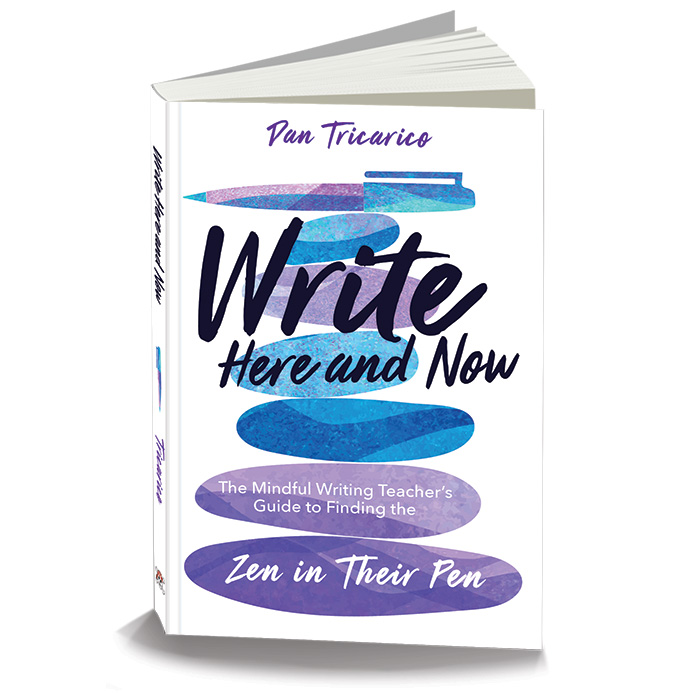
Write Here and Now
Make Every Encounter with Writing More Meaningful
More info →


