
Today's guest blog is brought to you by Becky Keene! Becky is an educator, author, and speaker specializing in instructional coaching, game-based learning, and integrating AI to empower student creativity. With over 20 years in professional learning and 15 years teaching and leading in public schools, she has also developed esports programs and explores immersive learning through games. A National Board Certified Teacher with an MS Ed in early literacy, Becky is the author of AI Optimism and speaks globally on AI in education.
Take it away, friend!
Guest Blog by Becky
We've all heard the grand promises about artificial intelligence revolutionizing education, right? But amid the sparkly headlines and dystopian warnings, what's actually happening in real classrooms? After spending the past two-plus years working with educators and students exploring AI integration, I've had to remind myself that we're not just talking about the future of education anymore - we're living it.
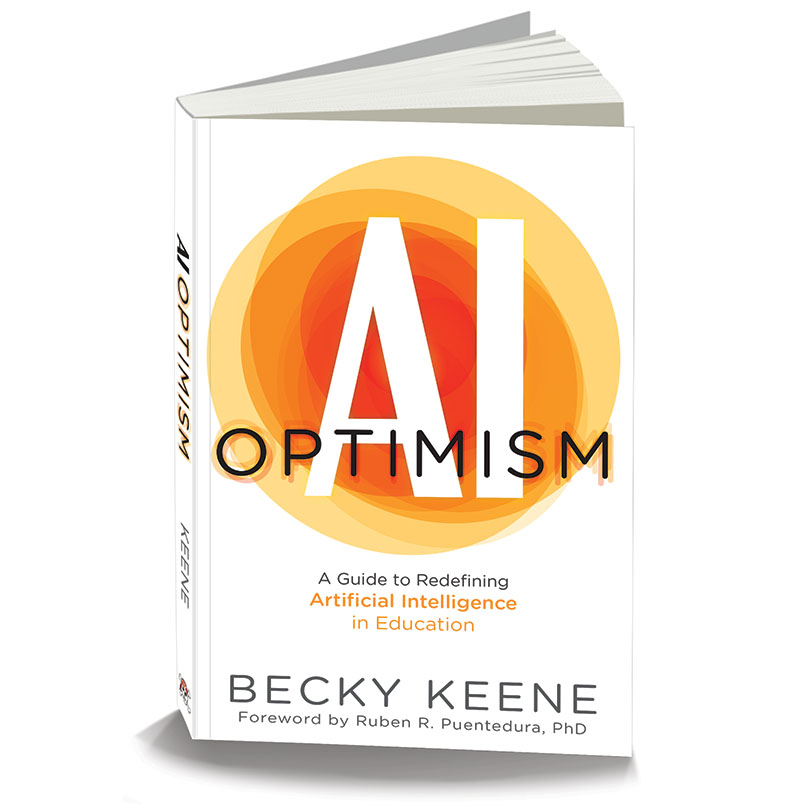
In my new book AI Optimism, I explore how my framework uses the SAMR model (Substitution, Augmentation, Modification, Redefinition) to provide a roadmap for implementing AI in ways that truly enhance learning rather than simply digitizing old practices. The most exciting developments aren't happening at the substitution level, where AI merely replaces traditional tools. Instead, they're occurring at what Dr. Ruben Puentedura calls the "redefinition" level. This where technology enables entirely new learning experiences that were previously impossible.
Here’s an excerpt from the beginning of the book that explains this transformation.
___
Imagine a classroom where a student who struggles with writing due to dyslexia is crafting an eloquent essay, guiding an AI assistant to help structure his thoughts while maintaining his unique voice. Nearby, another student who has never written a line of code is building a fully functional app that tracks local wildlife sightings, using AI to translate her ideas into programming language. Meanwhile, their teacher is reviewing personalized analytics that show not just what students know, but their misconceptions when solving math puzzles as well. The teacher sees learning gaps that would have been missed before.
I saw a glimpse of this potential when visiting a middle school science classroom. Let’s call the student Jake, a seventh grader who typically avoided writing assignments, was using an AI tool to help organize his thoughts for a climate change project. His teacher had noticed he could verbalize complex ideas fluently but would shut down when faced with a blank page.
With the AI assistant, Jake would speak his ideas aloud, then edit and refine the generated text. "It's like having my own personal thinking buddy," he explained to me. "I know what I want to say, but getting started was always the hardest part." His final project showed a depth of understanding that had previously been hidden behind his writing challenges.
What struck me wasn't just the quality of his work, but how the technology had revealed capabilities his teachers hadn't fully recognized before. The AI hadn't done the thinking for him. It had simply removed the barrier between his thoughts and their expression. Sometimes the most powerful technology isn't the one that teaches new content, but the one that allows students to demonstrate what they already know.
This isn't science fiction. This is education at the Redefinition level of SAMR with artificial intelligence. It's happening right now in forward-thinking classrooms around the world.
Artificial intelligence has been supporting humans for years. I won't attempt to write up a history of AI here, but if you're interested, just ask your favorite GPT to write a history for you, in your preferred language, with the level of detail you need. This book is focused on today, and the extraordinary tomorrow that's suddenly within our reach.
___
We're witnessing the emergence of what I call "AI Optimism"—an approach that neither fears technology nor embraces it uncritically, but instead focuses on how AI can amplify human potential and address persistent educational inequities.
AI will not replace teachers anytime soon, but it also won’t make learning effortless. Instead, I’m focused on the fact that AI can remove barriers that have historically prevented students from showing what they're capable of. When we move beyond using AI as a fancy substitute for worksheets and embrace its potential to redefine learning itself, we create opportunities for every student to discover and develop their unique strengths.
The future of education isn't about choosing between human connection and technological innovation. It's about using AI to create more space for the deeply human aspects of learning—creativity, critical thinking, collaboration, and connection. The educators who understand this distinction will be the ones who help change education for the better. Won’t you join the movement?
Thank You, Becky!
Thanks, Becky!
Love this post!
If you like what you've read, be sure to follow Becky on X right HERE and her website right HERE.
Also, grab her amazing book, AI Optimism, right here. You won't be disappointed!