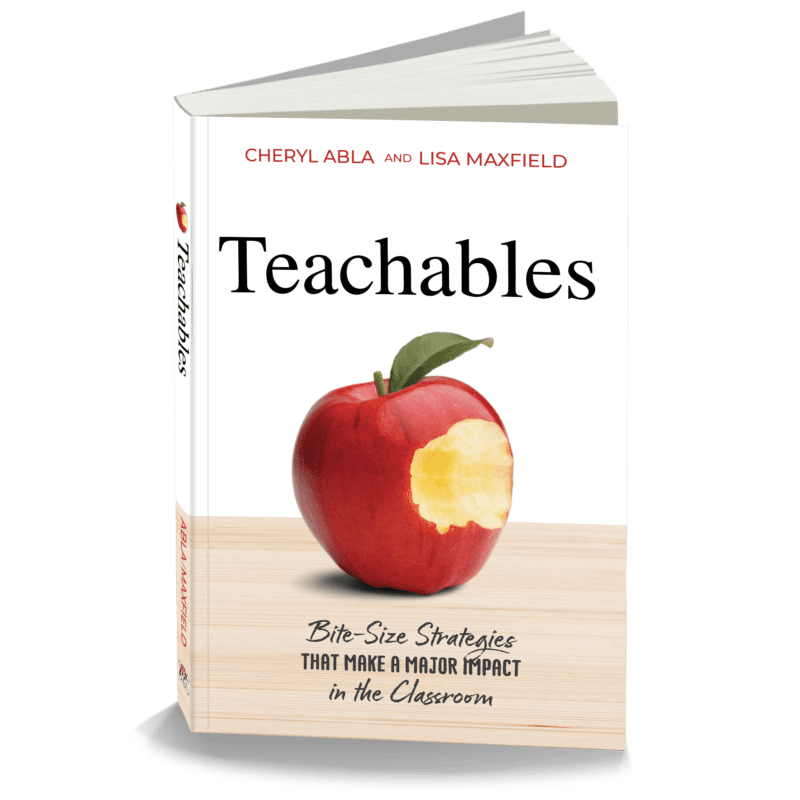

Today's Guest Post is brought to you by the co-authors of Teachables: Bite-Sized Strategies that Make a Major Impact in the Classroom, Lisa Maxfield and Cheryl Abla
Take it away, friends!
From Crossed Arms to Engaged Minds: Teaching with Intention
Arms crossed. Eyebrow raised. Scowl on the face. You already know what’s coming: “Ugh, why do I need to learn this?”
If you haven’t heard it out loud, you’ve seen the quizzical looks on faces. Let’s be honest, you probably asked the same question when you were a student. The thing is, it’s a valid question.
Effective teachers don’t wait for students to ask. They have already answered it for themselves: “Why do my students need to know this?” Do not avoid the “why” question, embrace it! The best lessons start with the teacher’s why and build on intentional moves that help students connect, engage, and retain what they learn. The strongest lessons consistently include five key components: start with the standard, engage with a hook, direct teach, process through academic talk, and check for understanding. Let’s break it down.
Start with the Standard: Identify the What and How
Always begin with the standard. Read it carefully and identify what students need to know and what they need to be able to do as a result of their learning. Create a learning target that is specific, measurable, and uses student-friendly language.
- Create a list of the concepts the students need to understand and the skills they need to demonstrate.
- Write simple and actionable “I Can” statements that students can easily understand.
- Use a rubric so students know what success looks like.
- Plan lessons so students learn both the what and the how.
- Ask students randomly throughout the lesson…”What are we learning today?”
Engage with a Hook: Grab Their Attention
Hook your students by sparking curiosity about what you will be teaching. Set the mood as students walk in to spark curiosity about what they will learn. Here are some ideas to try:
- Have students complete bell work or do-now activities.
- Play music to engage students.
- Dim the lights to set the mood.
- Display a picture to spark curiosity.
- Provide a specific smell to create an experience.
- Play a short video to introduce the topic.
- Show an interesting fact to grab attention.
- Pose a debatable question and let the students begin discussing.
Direct Teach: Make It Clear
Always start with the learning target. Students should know what they are learning and where they are headed. Before diving into your lesson, take a moment to discuss the target with your students.
Keep students actively engaged as you teach. Reference the learning target throughout the lesson to help them make connections between what they’re doing and what they’re learning. Mix in visuals, stories, and movement to keep energy high and make the lesson stick. Guided practice is essential. Give students a chance to apply new skills and provide feedback to help them improve. Direct teaching is not just telling. It is guiding, modeling, and supporting so students leave knowing both the what and the how.
- Plan pacing to hold attention and maximize engagement.
- Incorporate visuals, movement, and stories to make learning stick.
- Provide guided practice to prepare students for independent work.
- Give clear, specific feedback to correct errors and promote student growth.
Process Through Academic Talk: Let Them Talk It Out
Students need to discuss their learning to help them process. Mix-Pair-Share and its variations are excellent tools for this. Have students try one method several times before introducing another to keep things fresh.
- Mix-Pair-Share: Ask a question. Students stand up, mix around the room, then pair (when you announce it) with the nearest classmate to share.
- Think-Pair-Square-Share: After Mix-Pair-Share, have two pairs merge to form a group of four and share again with the square group.
- Think-Pair-Draw: Students draw as a way to express and share their ideas with a partner.
- Think-Time: Give students a few minutes to think independently before sharing.
- Think-Pair-Fishbowl: Half the students form an outer circle, the other half form an inner circle. Students share and then the inner circle rotates to a new partner.
Check for Understanding: Know What They Know
Even the best lesson won’t stick unless you know what your students actually understood. Students do not all learn at the same pace, so frequent checks for understanding are essential. Quick checks help you see when to reteach or give targeted support. They also give students the chance to reflect on their learning.
- Thumbs-Up: Students show thumbs-up, sideways, or down to indicate understanding. When a safe classroom environment is established, it allows for honest responses.
- Listen: Pay attention to discussions during academic talk to gauge understanding.
- Poll Apps: Use tools like Poll Everywhere or Kahoot to gather immediate data.
- Exit Tickets: Have students summarize their learning at the end of class to inform future instruction.
Intentional teaching means every move in your classroom has a purpose. From the hook to the closing, you are showing students not just what to learn but why it matters. The next time you plan a lesson, pause and ask yourself: Why does this matter? How will my students know it matters? And what will they do with the knowledge? Answering those three questions can turn a good lesson into a powerful one.
Every crossed arm, every quizzical look, every whispered “Why do I need to learn this?” is a chance to show that your lessons have purpose. When you teach with intention, you transform those moments into curiosity, understanding, and meaningful learning.
Thank You, Lisa and Cheryl!
If you'd like to explore more, be sure to follow their website HERE!
Here are the additional resources for this activity: Overview Video, Lesson Plan Template, and the Infographic!
Also, don't forget to check out their book, Teachables: Bite-Sized Strategies that Make a Major Impact in the Classroom, RIGHT HERE!