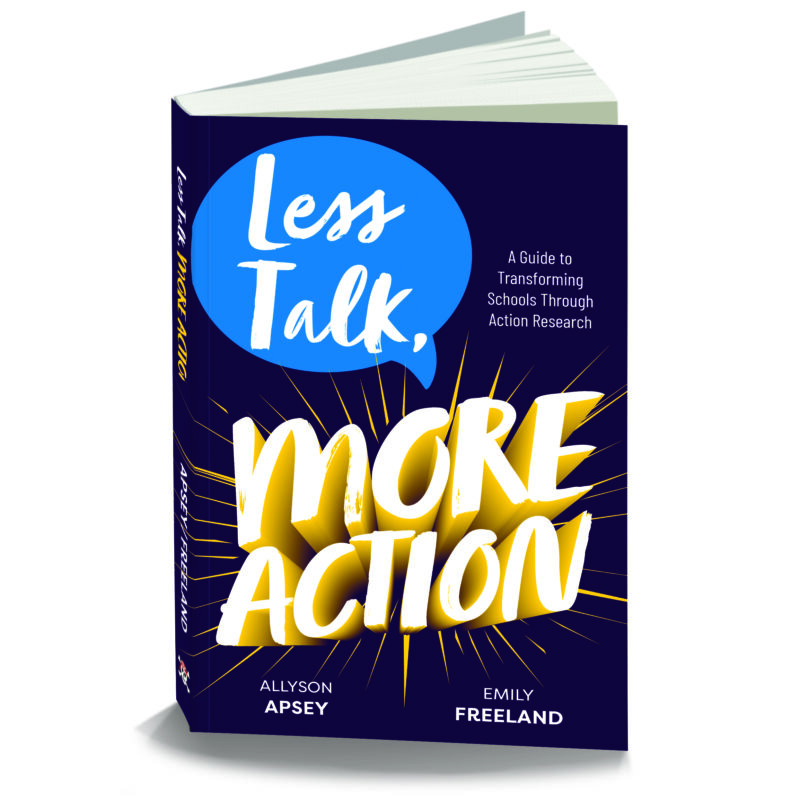
Today’s guest post comes from Allyson Apsey and Emily Freeland, Ed.D., co-authors of Less Talk, More Action. With a combined 50+ years in education, they’ve led schools, coached leaders, and inspired countless educators to move from good intentions to impactful action.
Guest Post
We tend to be a little wary of salespeople because we’re never quite sure if they have our best interests in mind. When someone works hard to convince us to buy, we start to wonder why persuasion is necessary; if the product truly delivers, shouldn’t it speak for itself? The same dynamic often plays out in schools. When leaders push hard for “buy-in” around a new initiative or goal, their teams can start to question the motive or the merit. We’ve been conditioned to believe that effective change requires universal agreement, but research and experience tell a different story. It’s not belief that drives behavior; it’s behavior that shapes belief.
Rethinking Buy-In
The idea of buy-in has long been seen as essential to successful change in schools. Borrowed from organizational change theory in the business world, it was designed to boost motivation and reduce resistance by securing early agreement and emotional support.
In theory, it sounds great: if people believe something will work, they’ll be more committed to it. But in practice, it can feel a little like manipulation, and it overlooks a key truth. Belief doesn’t always come first.
Our beliefs are built on experience. Psychologists call this experience bias, the tendency to trust what we’ve lived more than what we’ve been told. Allyson’s teenage son is adamant that the only way he learns life lessons is “the hard way”. And, although they hope he heeds the advice of his parents once in a while, the truth is that he is not wrong. We’ve all learned something “the hard way,” and those experiences often stick far longer than any directive or data slide ever could.
So when educators resist change, it’s rarely about apathy. It’s about being asked to shift deeply held beliefs that are often tied to professional identity before having a chance to experience something new. After years of “the next big thing,” it’s understandable that many educators hesitate.
Why Try-In Beats Buy-In
If we want to shift beliefs about teaching and learning, we must start by creating new experiences. The biggest changes don’t come from PowerPoints or pep talks. They come from trying something new, seeing it work, and feeling the impact firsthand.
That’s where the idea of try-in comes in.
Try-in replaces the pressure to believe with an invitation to explore. It says:
“You don’t have to believe in this yet, just try it with me and see what happens.”
The shift from convincing to inviting turns compliance into curiosity and creates the space for authentic engagement.
Here’s why try-in is more powerful than buy-in:
- It honors teacher expertise. Educators aren’t just implementers; they’re innovators. Try-in values their voice and experience.
- It fosters authentic engagement. When we help shape the process, commitment comes naturally.
- It leads to real results. Trying something in context allows for faster feedback, learning, and improvement.
- It models what we want for students. Just like our students, we need space to explore, reflect, and grow.
Learning Together
Here’s the truth: we’re not meant to try alone. When we build a culture where everyone is learning together, vulnerability becomes strength. The question shifts from “What if this doesn’t work?” to “What might be possible if we did this together?”
In these spaces, mistakes become data, not failures. They become stepping-stones to insight, clarity, and confidence. As Doug Reeves reminds us, “People don’t believe what’s written in PowerPoints—they believe what they see with their own eyes.” Experience is the evidence that changes minds.
A Simple Way to Start: “Pass It On”
One way to bring try-in to life is through a staff activity called “Pass It On.” It taps into the creativity and expertise already in your building and spreads what’s working—one small idea at a time.
Purpose: Celebrate innovation, build collective efficacy, and share what’s working.
How It Works:
- Set the Stage: Ask each teacher to bring one “bright spot”—something new they tried that made a difference.
- Share the Wins: In small groups, teachers take 1–2 minutes to share their ideas. Keep it quick and energizing.
- Capture the Gold: Listeners jot down ideas they’d like to try using sticky notes or a recording sheet.
- Choose One to Try-In: Each teacher picks one idea to test in their classroom over the next couple of weeks.
- Follow Up and Celebrate: Reconnect at the next staff meeting to share how it went and what was learned.
The Bottom Line
Change doesn’t begin with belief; it begins with experience. When we replace buy-in with try-in, we give ourselves and our colleagues permission to experiment, reflect, and grow.
So, what’s one thing you’ll try in this week?
Thank You, Allyson and Emily!
Wow! Now, that is doable! How might you create joy ten feet at a time?!
Be sure to check out their new book, Less Talk, More Action: A Guide to Transforming Schools Through Action Research!